

Leave it on, and watch it. Shopify's agentic storefronts put your products inside AI chat apps, and if your store is eligible, Shopify signs it up for every new app it adds.
That is how eligible stores' products reached Meta on 8 September 2026, the day Meta launched Muse. Muse is an AI agent that, in Meta's words, can "open a browser, fill out forms, and negotiate" for the people using it. Auto-enrolment is also why a row called Other channels, for startups building experimental shopping agents, is switched on in my store's admin. On Meta, Google and Microsoft Copilot, if your store qualifies, customers can also pay without leaving the chat.
ChatGPT, Google, Copilot and Meta charge you no fees today, and overall there is no reason to disable it. The number of shoppers at the top of the Agentic page in your Shopify admin counts visits to your store from AI chat apps, mostly people who clicked a link. It does not count agents buying.
Shopify Signs Eligible Stores Up For Every New AI Channel By Default
The setting is called "Allow Shopify to manage for me". It sits at the top of Sales channels > Agentic in your Shopify admin, and it stays on unless you turn it off. Shopify's documentation says what it does: "Agentic storefronts channels have access to your products through Shopify Catalog. Direct checkout is activated for the relevant channels. You're auto-enrolled in new agentic storefronts channels."
Shopify Catalog is how most of these apps get your product list. Google is the exception, it reads your products from Google Merchant Center.
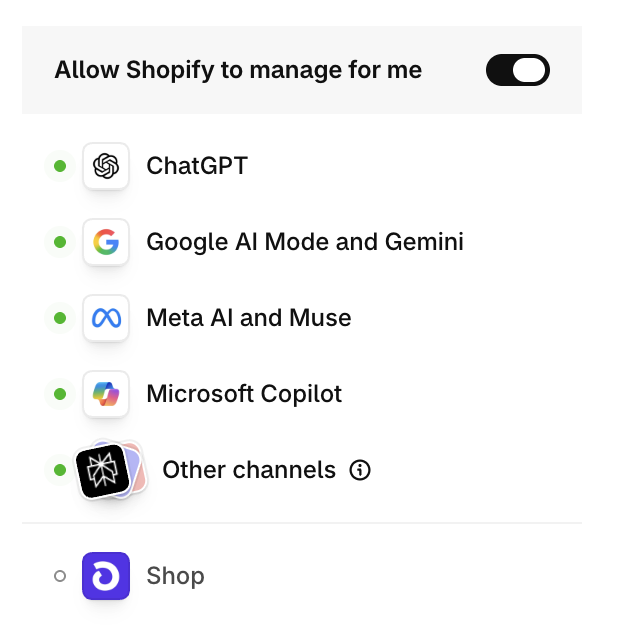
Meta arrived through this setting. Shopify's changelog entry for 8 September 2026 says "Your products are shared with Meta by default through Shopify Catalog." Amazon blocked Muse from its store on 20 September 2026, twelve days after Shopify shared its eligible stores' products with Meta. The admin describes the Other channels row as "Other AI-powered platforms like Perplexity that can surface your products to shoppers." Shopify's help page says the group includes "Independent developers and startups that are building niche or experimental shopping agents" and "New third-party partners that have recently gained access to Shopify Catalog for testing."
Shopify first opted merchants in automatically on 12 January 2026. If you followed my May 2026 advice and checked that this channel was on, the same setting now shares your products with Meta and with whoever is in the Other channels row.
HOW AI IS CHANGING THE INTERNET: THE GOOD, THE BAD, AND THE POINTLESS
Nobody asked us if we wanted the internet changed. So every week I send one email about one thing AI did to it, with the receipts, and what to do about it. Sometimes the honest answer is "not yet."
From someone who pays attention to this for a living.
On Meta, Google And Copilot, Shopify Customers Can Pay Without Visiting Your Store
Shopify calls this direct checkout. The customer pays in a Shopify checkout inside the chat app and never opens your website. It is on by default on all three, for stores that qualify:
- Meta: stores that sell to the United States, Canada or Mexico (Meta page).
- Google AI Mode and Gemini: US stores selling to US customers, with a Google Merchant Center account (Google page).
- Microsoft Copilot: stores selling in the US (Copilot page).
ChatGPT sends the customer to your store's checkout, which Shopify's ChatGPT page describes as "your online store checkout in a ChatGPT in-app browser, or in a new tab when customers use ChatGPT web."
When the customer pays inside the chat app, the tracking code on your website does not run. Shopify says Google Analytics and custom pixels "won't fire" in the Google and Copilot checkouts (only server-side tracking does), and that third-party analytics pixels "don't fire" in Meta's. Shopify still records the order: Meta orders "are displayed in your Shopify admin in the same way as for any other sales channel." If you check your sales in Google Analytics or an ad dashboard instead of Shopify, you can miss these.
You Can Turn Off Shopify's Auto-Enrolment Or Any Single Channel
Turn off "Allow Shopify to manage for me" and, on my store, three switches appear: Shopify Catalog access, Auto enroll new storefronts, and direct checkout. Each channel also gets separate switches. With Auto enroll new storefronts off, you keep the channels you have and stop getting new ones.
Meta and Copilot each have a switch for catalog access and one for direct checkout. ChatGPT has only catalog access. Google has only direct checkout, though Shopify says your products still have to be eligible for Shopify Catalog.
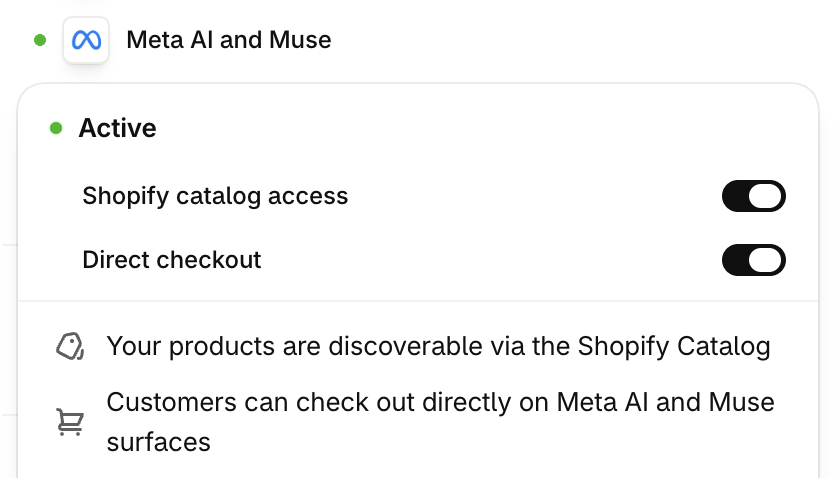
If you turn off catalog access, Shopify says it can take "up to 7 days before your product data is no longer being shared through Shopify Catalog." To hide a single product from AI apps, you have to mark it as unlisted, and Shopify's product page says that "also hides the product from sitemaps, search engines such as Google, and your online store search."
Shopify's AI Channels Charge No Fees For Now, And Meta Expects A Cut
As of September 2026, Shopify's help pages for ChatGPT, Google, Microsoft Copilot and Meta say none of them charges a fee, and you pay only your usual payment processing fees. You are also still the seller. The Meta page says "You remain the merchant of record, and you continue to manage fulfillment, returns, and customer service for these orders."
Meta expects the no-fee part to change. Mark Zuckerberg told Alex Heath on the Sources podcast, in an episode published on 8 September 2026, that for Muse "the business model over time that we expect is to effectively just take a very small cut of whatever the transaction is," and that "It'll come from the businesses that they're working with." I have found no stated plan like that from Google or Microsoft. Episode 233 of the podcast, Muse Is Why Meta Has No Business Building The Agentic Web, goes through what Meta has said about Muse, the cut included.
The Shopper Count On Shopify's Agentic Page Counts Visits From AI Apps
The number of shoppers at the top of the Agentic page counts visits to your store that came from AI chat apps. On my store the page opens with a line saying how many shoppers "AI agents have sent" to the store in the last 30 days, and that number matched the page's online store sessions, which Shopify's documentation defines as "the total number of visits to your online store from an AI channel over a specified time period." A direct checkout does not open your website, so a purchase made that way does not add to this number.
Since late September 2026, Shopify removes the bots it can identify from its visit reports. It does not say whether the Agentic page uses the same data. If it does, most of these visits should be people: someone asked ChatGPT a question, got a link to your product, and clicked it.
The shopper count sits under Sales channels > Agentic, but it is not agentic shopping. It is LLM-referred traffic, people sent to your store by an AI chat app's answer. Purchases an agent completes for someone show up in the page's sales figure, and Shopify says that figure mixes "referral-based sales and sales that happen through direct checkout."
The clicks are real. Shopify said in August 2026 that in Q2 "AI-referred sessions to Shopify storefronts grew 197% (roughly 3x) year-over-year and orders also grew 3x." For purchases an agent completes inside a chat app, I have seen no numbers, from Shopify or anyone else. Default-on proves nothing until real agents use it, and direct checkout is where that gets tested. Because the sales figure mixes both kinds of sale, the orders list filtered to Meta is the closest view of what Meta's checkout sold.
Filter the orders list by channel once a month and see what the feature really means for your store. That is the number Meta's cut would come out of. I would still leave everything on, and keep a very close eye on what Shopify adds to the channel list.