
CUSTOMERS ASK AI ABOUT YOUR BUSINESS. I CHECK THE ANSWERS, TRACE THE WRONG ONES AND FIX THEM.
Before people buy, they ask ChatGPT, Gemini, Perplexity or Google's AI about your products, returns and delivery. Whatever the assistant says is what that customer believes. AI answer accuracy is a service from No Hacks that checks those answers for any business whose customers ask AI before they buy, finds the page each wrong answer came from, fixes it there, and asks again to show what changed. It starts with a free finding on one question.
Start with the free finding.
One question your customers ask before they buy, put to ChatGPT, Gemini, Perplexity, Google AI Overviews and AI Mode, and Copilot. What they said, where they got it, and what your website says, back within a week. It costs nothing.

Slobodan “Sani” Manic does the work: founder of No Hacks, former CTO of Search Engine Journal. Full profile
- The question
- Can I return this if it doesn't fit?
- Where it came from
- An old marketplace listing
- The assistants said (wrong)
Returns are accepted within 14 days of delivery.In 4 of 5 answers- Your page says (correct)
- 30 days, free returns.
- Verdict
- Wrong, and traced to one listing.
- The fix
- Correct the listing. Make your returns page the answer the assistants find first.
WHY THIS MATTERS
Customers ask the assistant before they reach you.
A shopper asks ChatGPT or Google about your returns, delivery or fit and reads the answer instead of your page. That answer is their first impression of your business, and you did not write it.
You cannot see any of it.
There is no ranking to check and nothing in your analytics. Someone who got a full answer has no reason to click, and each person gets a separate answer that can change from one day to the next.
A wrong answer costs money.
A wrong return window costs the sale. A wrong compatibility answer brings back a return. A wrong delivery area ends up in your support inbox. In some categories, a wrong answer about safety or use becomes a liability.
Your website can be right and the answer still wrong.
The assistants read more than your website: an old marketplace listing, a PDF from two years ago, a review, a reseller's page. Fixing your website alone does not fix an answer that came from somewhere else.
A fact that is right on your page can also be missing from what an AI reads, if it appears only after the page's scripts run or loads only when someone opens a tab.
Your SEO report does not cover it.
SEO reports track rankings and traffic. AI tracking tools count how often you are mentioned and give you a score. Neither says whether what was said is true, and neither fixes it.
Who it is for: any business whose customers ask ChatGPT, Gemini or Google's AI before they buy. Most exposed, in four situations: people check before they buy, your details change, other websites talk about you, or a wrong answer carries risk.
HOW IT WORKS
The work answers two questions. What is AI telling people about your business, and is it right? Where is it getting that from? Then the wrong answers get fixed, which is where most services in this space stop and hand you a report. The full fix is the six steps below, with the first round of fixes included. After it, the monthly re-check asks the same questions every month.
Map the business.
Everything your business covers gets listed: the company, the people behind it, every product, plan or location, your policies, the questions customers ask about each, and the things they ask about that you do not cover at all.
Check your sources.
Everything the assistants read about you goes into one fact sheet: your website, product feeds and structured data, business profiles, marketplace listings, review sites and Wikidata. Two pages that disagree, a fact that lives only in a PDF, a question nothing answers: all of it shows up here, before any assistant has been asked.
Ask the assistants.
Every question goes to ChatGPT, Gemini, Perplexity and Google's AI, many times over. Every answer is recorded with every page it cited and, where the assistant shows it, what it searched for and every page it looked at, so you can see what they say about you and whether it is right. The same questions also go out with web search switched off, which shows what each model believes about you from training alone.
Every answer gets checked against what your website says. An answer that contradicts your website is a finding. So is an answer that states something your website never says, and so is a competitor recommended where you should have been named. So is an answer that gets the fact right but hedges, "the company says…" or "I couldn't confirm". The hedge usually traces to an old page, often one of your own. Being cited isn't being recommended. An assistant can use your page to explain the topic, then name your competitors.
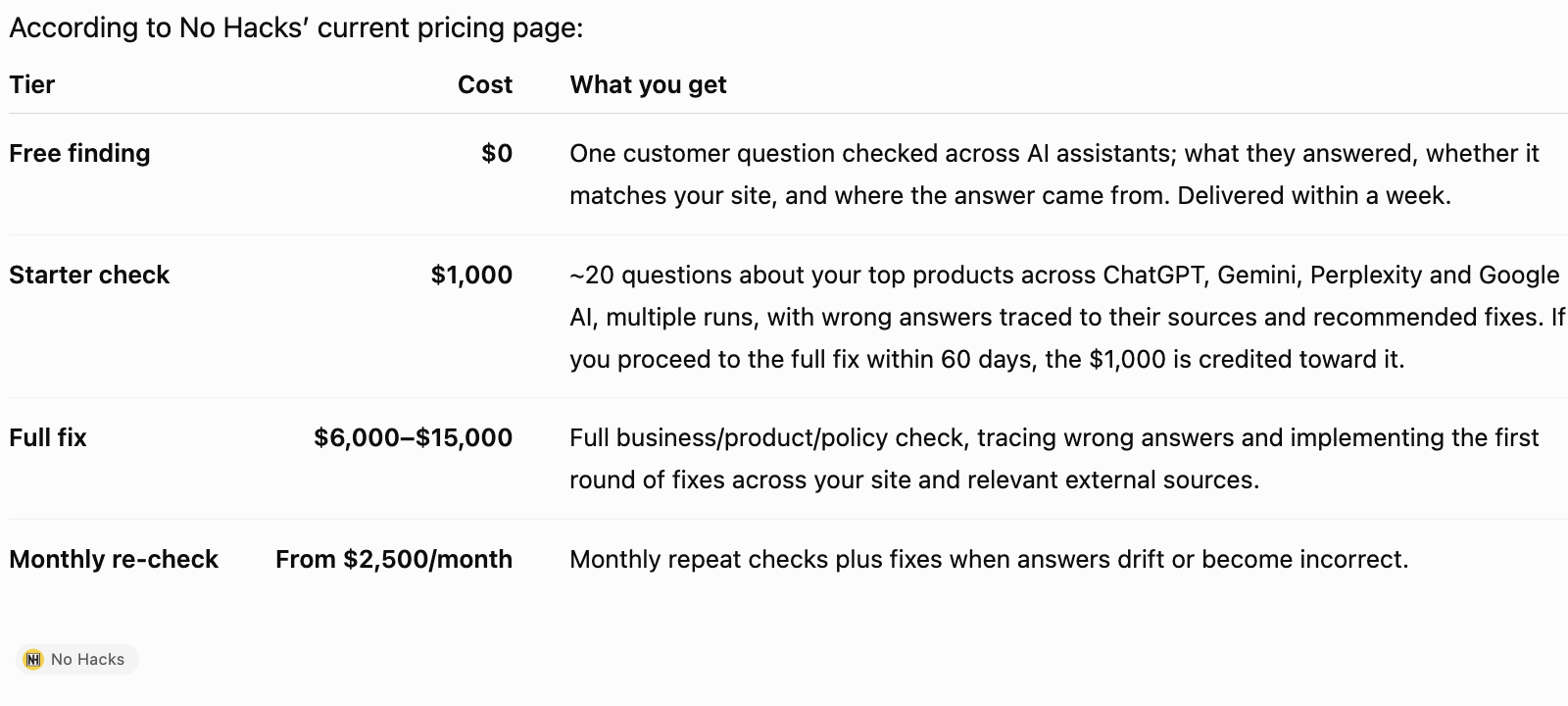
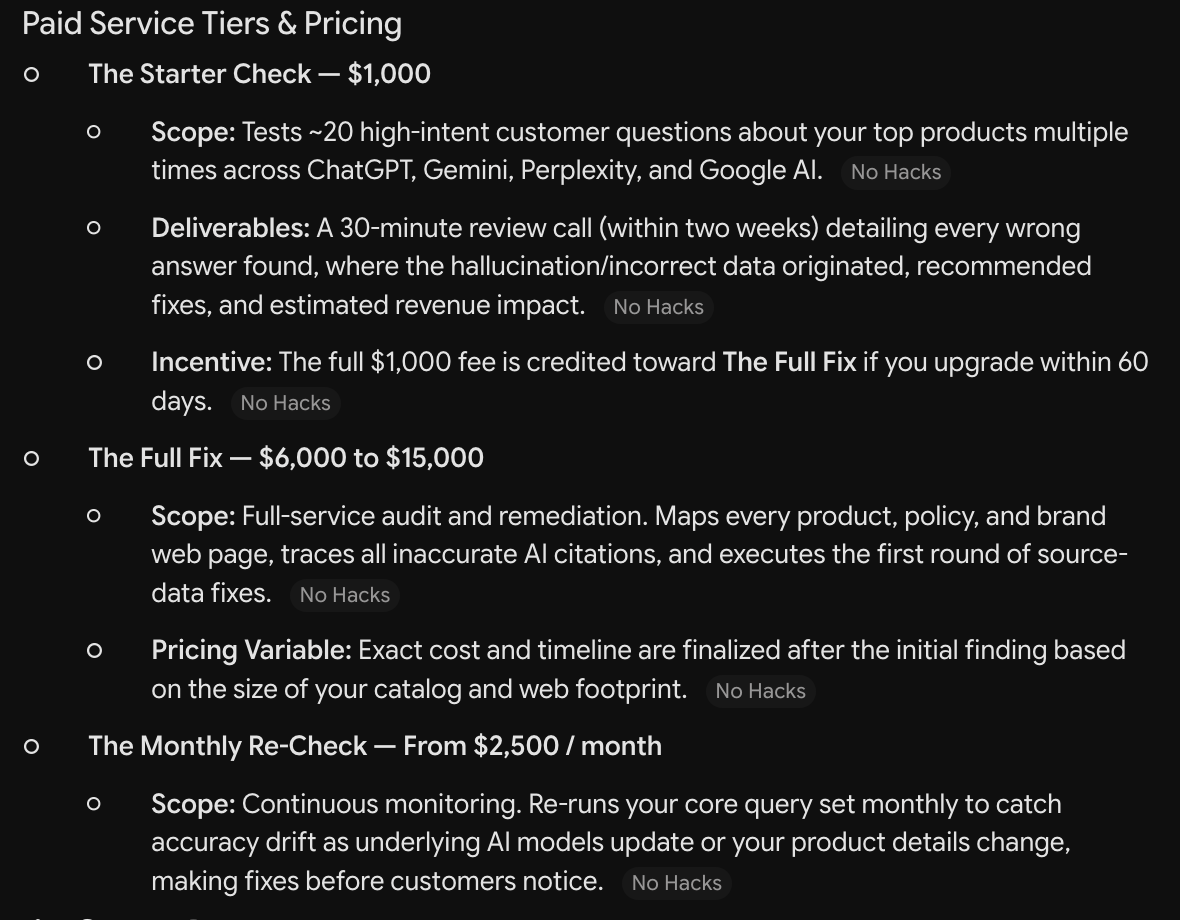
Two real ones, 7 October 2026. ChatGPT with web search on, then Gemini, each asked “What does No Hacks' AI answer accuracy service cost, and what do I get for free?” ChatGPT
Gemini
- Checked against
- The four prices on this page. Every figure matched, in both answers.
- Where it came from
- This website's pricing page, cited by both.
- Verdict
- Right, in two answers out of two, one per assistant. Nothing to fix.
Trace every wrong answer.
Every page an assistant cited gets opened and read. Either it says what the assistant claims or it does not. Each wrong answer now has a cause, and the cause decides the fix.
Fix it at the source.
You get a one-page answer to "what does AI say about us?" and every wrong answer with its cause and the change that fixes it, starting with whatever stops a sale or causes a return. Then the changes get made, wherever the answer came from: your website, your feeds and structured data, your profiles and listings, review sites, Wikidata, a page someone else controls, and anything in how the website is built or served. Each fix arrives as a ticket with the evidence attached or, where we have access to the website's code, as a tested change ready to go live.
Some fixes are a sentence on a page. Others sit in how the website is built and served: a price or stock status that appears only after the page's scripts run, a template that shows a placeholder where the delivery time should be, a help centre that arrives empty when a machine requests it, a fact that exists only in a PDF, a new page no other page links to, so the assistants never reach it. Those get fixed too, with whoever runs your website.
See what moved.
Once the fixes are live, the same questions go out again and the new answers sit next to the old ones. You see which answers changed, fix by fix.
Where the wrong answers come from
What the trace in step 04 finds, and the fix each cause gets.
- It came from something you own.Your page, product feed, structured data, profile or listing says the wrong thing, or says two different things. It gets changed.
- It came from someone else's page.A retailer listing, a review, a forum thread or an old article, none of which you can edit. It gets corrected, or the right fact goes on a page of yours that the assistants find first.
- It came from no page at all.Your website never states the fact, so the assistant filled the gap. The missing fact gets published where the assistants read.
- It found your page and used another.The assistant read your page and chose a different one. Your page gets rewritten so it answers the question outright.
Where you end up
After step 06.
- You know what AI tells people about everything you sell, and whether it is right.
- The wrong answers are fixed at the source, on your website and off it.
- Your website agrees with itself and answers what customers ask before they buy.
- You can see which answers changed after the fixes, with the assistant, the date and the source on record.
- When someone above you asks what AI says about the business, you have the answer.
One question, free, back within a week.
WHAT IT COSTS
Four steps, in this order. You can stop after any of them.
1. The free finding
Free
One question your customers ask before they buy goes to the assistants. You get what they said, where they got it, and what your website says, within a week.
Get the free finding2. The starter check
$1,000
Comes off the full fix if you go ahead within 60 days.
About 20 questions on your top products go to ChatGPT, Gemini, Perplexity and Google's AI, several times each. You get every wrong answer, where it came from, what to fix and where, and what each one costs you, on a 30-minute call. It comes back within two weeks.
3. The full fix
$6,000 to $15,000
The range follows the map: how many products, plans and policies there are, and how many questions customers ask about each.
Every product, policy and page about your business gets checked, every wrong answer gets traced, and the first round of fixes gets made, in the six steps above. The price and the timeline are set after the free finding, by how much there is to map.
4. The monthly re-check
From $2,500 a month
The same questions go out every month. The assistants change, your catalog changes, and answers that were right drift. Sources drift too: a report replaced at the same address every year turns last year's correct figure into this year's wrong one. When one goes wrong, it gets fixed, and you hear about it from us before a customer tells you.
What you can rely on
- Every reported answer names the assistant, the date, the market, and how many times out of how many it came back. You can check any of it yourself.
- Every source behind a finding is opened and read. Anything that could not be checked is listed as unchecked, with the reason.
- Nobody here promises more sales. You get a record of what is being said and where it came from, a fix for every wrong answer, and a second round of answers that shows whether the fixes moved them.
Clients have no say in what No Hacks publishes, and no client is named on the podcast or in the publication without agreeing to it in writing. No Hacks runs no sponsorships. The publication is funded by this work.
Not on offer: the check on its own without the fix, a full fix where nobody on your side can change the website, or publishing your results without your agreement at signing.
Contracts and invoicing run through Web Performance Tools.

Slobodan “Sani” Manic, founder of No Hacks and former CTO of Search Engine Journal, does the work.
No Hacks is his podcast, newsletter and publication about the agentic web, without the hype. Search Engine Journal, where he was CTO, now syndicates his articles. His background is payment integrations, conversion work and web performance, and he is a WordPress Core Contributor. Full profile
WHAT PEOPLE ASK
- Why does ChatGPT give wrong information about my business?
- Assistants build answers from every page they can find about you, and the pages disagree. An old marketplace listing, a two-year-old PDF, a reseller's page or a forum thread can outweigh your current website, and when your website never states a fact, the assistant fills the gap. The fix is finding which page each answer came from and correcting it there.
- How do I fix what AI says about my products?
- Trace each wrong answer to the page the assistant cited, then correct that page. When it is yours, change the product page, feed, structured data or profile. When it belongs to someone else, get it corrected or publish the fact clearly on your website so the assistants find it first. Then ask the same questions again to see which answers moved.
- Can I change what Google's AI Overviews say about my store?
- Nobody outside Google can edit an AI Overview. What you can change is the pages it is built from. AI Overviews and AI Mode cite pages, and each one can be opened and checked. When your pages, feeds and listings state a fact clearly and agree, the answer has a better source. Google decides what it shows, so the result gets checked, never promised.
- How is this different from an AI visibility tool?
- A tracking tool counts how often you are mentioned and gives you a score. A citation count cannot show whether your page recommended you or only explained the topic. This service checks whether what the assistants say about you is true, traces each wrong answer to the page it came from, fixes it on your website, feeds, profiles and third-party pages, and asks again to show what changed. The two can run side by side.
- How much does it cost to fix AI answers about my business?
- The first finding is free. The starter check is $1,000, and the whole amount comes off the full fix if you go ahead within 60 days. The full fix is $6,000 to $15,000, set by how much there is to map, with the first round of fixes included. The monthly re-check starts at $2,500 and includes the fixes that come out of it.
GET YOUR FREE FINDING
One question your customers ask before they buy goes to the assistants. You get back what they said, whether it matches your website, and where they got it, within a week. It costs nothing and commits you to nothing. If what comes back matters, we talk about the starter check or the full fix.
- The assistants said (wrong)
Returns are accepted within 14 days of delivery.In 4 of 5 answers. Source: an old marketplace listing.- Your page says (correct)
- 30 days, free returns.